Written by Ali Martin, Legal Program Manager
San Diego El Niño Is Here. Is Our Stormwater System Ready?
Emergency declarations. Unprecedented coastal flooding. King Tides. Kelvin Waves. This year’s event is on track to be the strongest on record—and San Diego’s water infrastructure, especially its stormwater system, is nowhere near ready for it. Here’s what to expect, what the City is doing, why our neglected system is in trouble, and what you can do to prepare.
What is El Niño?
The El Niño and La Niña cycles are the warm and cool phases of a naturally occurring cyclical pattern of weather called the El Niño-Southern Oscillation (ENSO) that originates in the tropical areas of the Pacific Ocean. These two phases create extreme shifts in global weather patterns, ocean conditions, and air pressure.
The term El Niño dates back to the 1600s, when South American fishermen first noticed periods of unusually warm water in the Pacific Ocean. The full name they used was “El Nino de Navidad,” because the effects of El Niño usually peak around December.
El Niño (warm phase): El Niño is generally caused by the warming of surface waters that move toward North and South America, as well as the weakening of trade winds to the east. The effects of El Niño vary by region, but here in San Diego and Southern California, it usually means a cooler, wetter winter. This can translate to heavier rain and a greater risk of flooding. El Niño also warms the ocean, and warmer water expands, which pushes local sea levels higher. However, it’s important to keep in mind that these are tendencies, not guarantees. Not every El Niño plays out the same way.
La Niña (cool phase): La Niña is the opposite of El Niño, and is usually associated with cooler sea surface temperatures and stronger trade winds. The West coast along North America sees an increase in upwelling, meaning colder sea surface temperatures and an increase in nutrients.
What can we expect this year?
You may have seen headlines warning that San Diego is about to be hit by a massive El Niño storm. However, the reality is more nuanced. El Niño isn’t a single storm but a climate pattern that shifts weather over many months.
It’s already here and strengthening: NOAA now gives a greater than 90% chance of a very strong event this fall and winter, with a 75% chance it becomes historic, exceeding any El Niño on record since 1950. For context, NOAA declares an El Niño when temperatures at the equator of the Pacific Ocean are 0.5°C (0.9°F) above average for several consecutive months, and a “very strong” El Niño when these temperatures exceed 1.5°C. Temperatures are currently tracking 4.0°C (7.2°F) above normal, leading some to call current conditions a “Godzilla” El Niño. This tilts the odds toward a significantly wetter winter for Southern California, but it doesn’t guarantee one.
Even though El Niño is a naturally occurring phenomenon, human-induced global warming and climate change can raise the underlying baseline temperatures. Higher baseline temperatures fuel the fire for El Niño, and as the planet gets warmer, we will be seeing more intense impacts with El Niño.
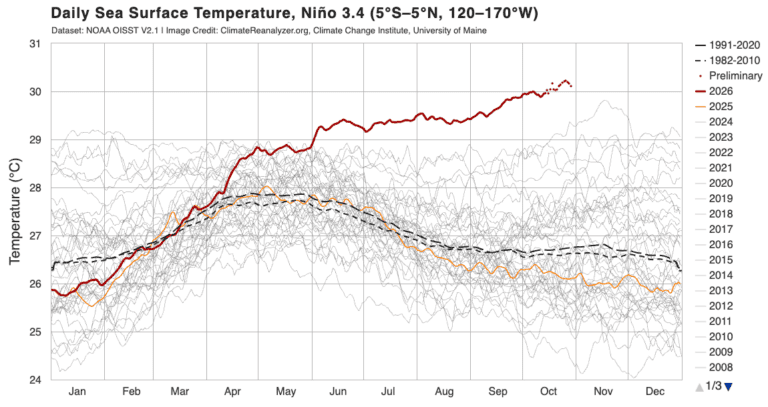
From Climate Reanalyzer
How will this affect San Diego?
California has already seen, and will continue to experience, accelerated erosion, flooding, and unusually high surf along the coast. Throughout this past summer and into the fall season, our coasts have also experienced record temperatures during this marine heatwave, slightly increasing air temperatures and humidity along the coast. California officials aren’t taking any chances. Cities across the entire state are gearing up for an intense fall and winter, with some cities like San Diego already declaring a state of emergency.
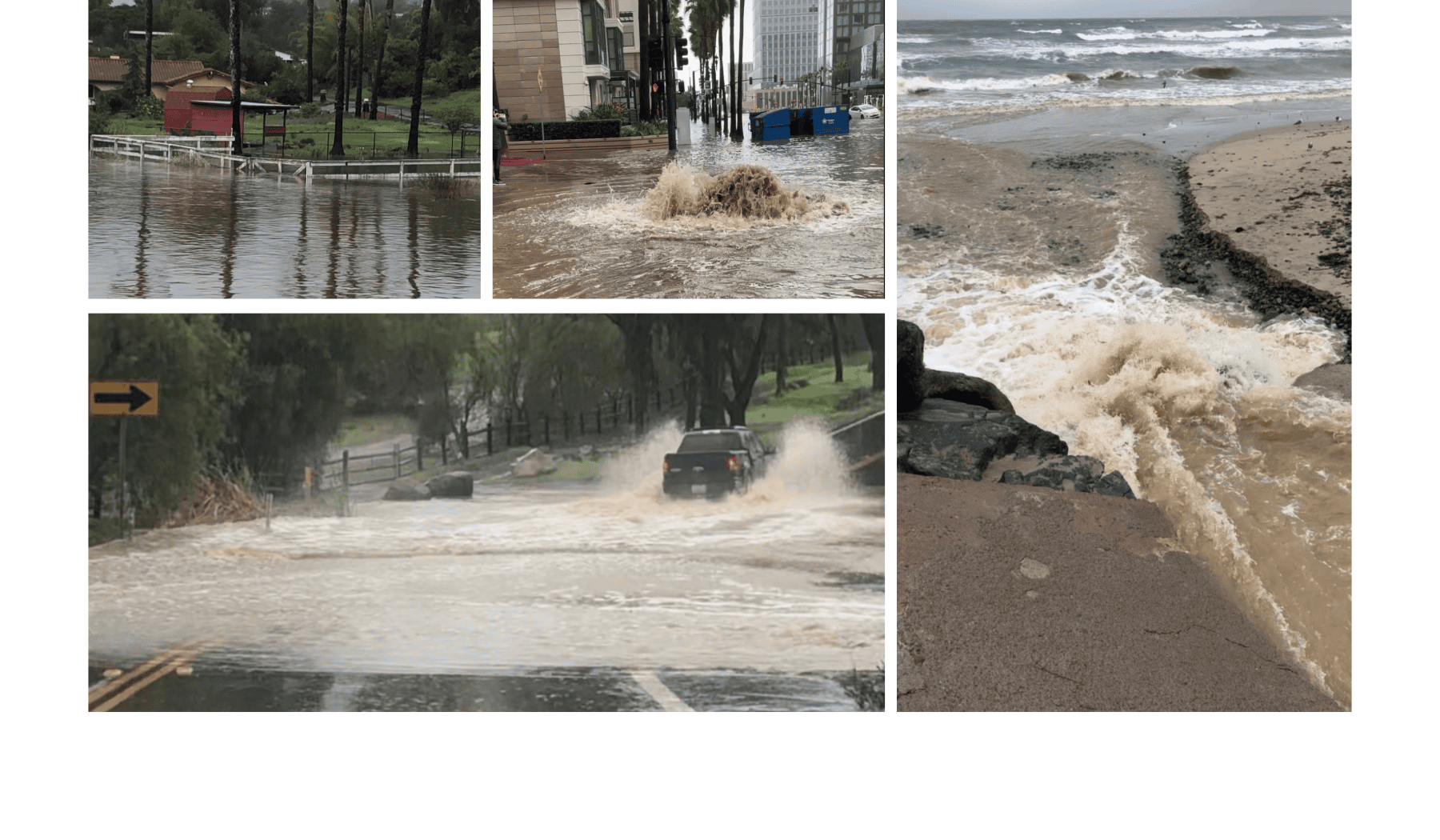
You may recall that we have already suffered from an extreme storm event back in 2024, bringing record-breaking rain which displaced 1,225 households and caused $31 million in public infrastructure damage costs. The rainfall produced the city’s 4th wettest day on record, dumping 2.73 inches of rain at San Diego airport, cutting off traffic. The floods impacted both residential and commercial areas, damaging homes, vehicles, storefronts, and essential infrastructure. Families were forced to evacuate on short notice, some losing important personal belongings and critical documents. Small businesses, which are already vulnerable to economic pressures, were subject to sudden closures and expensive repairs. Rivers and waterways became significantly polluted as trash, fertilizer, pet waste, and industry runoff dump into river channels and eventually feed into our beaches.
Chollas Creek and the San Diego River are extremely susceptible to flooding and pollution from massive storm events.
In our limited wisdom, human development expanded right up to the banks of these waterways, which used to meander. In a misguided effort to prevent flooding, and protect infrastructure, we paved the banks of these waterways, turning natural systems into stormwater channels that were designed for a climate and rain patterns that no longer exist. As climate change continues to intensify, San Diego is expected to have flashier, heavier rainfalls. However, because we have paved over most of our natural soils (which would otherwise absorb rain like a sponge), storm water from these heavier rains routinely exceeds the capacity of our shrunken and hardened waterways, so it ends up in our homes, businesses, roads, and other critical infrastructure.
What has the city been doing to prepare for El Niño?
With the painful memory of the 2024 devastation still lingering, San Diego is gearing up for even worse flooding because of this year’s El Nino. . During the summer, the City’s stormwater department has been gearing up for a gnarly rainy season by inspecting stormwater drains and clearing vegetation and debris. Crews have inspected over 300,000 drain inlets, prioritizing areas that have been heavily impacted by the 2024 floods. Preliminary preparations started in June, when the city formed a large working group with employees from 24 departments to identify gaps in past flood responses and better prepare the city for this upcoming storm. There has also been a big push to reach more San Diego residents, especially those living in high flood risk zones, and notify them of evacuation zones, and share emergency preparedness information.
While these efforts matter, they’re also a bit like tidying up an old house with an unstable foundation. The bigger issue in this matter is the aging stormwater infrastructure that hasn’t been updated since the 1940’s.
You may hear experts say that the city’s stormwater infrastructure can’t handle a 100-year storm. But what does this actually mean? A 100-year storm doesn’t mean that an intense storm happens every 100 years. It means there is a 1% likelihood of an intense storm in any given year, based on historical weather data. You can think of it like rolling a 100-side dice each year. It’s unlikely it will land on the number, but not impossible, and with a warming climate, the odds are ever increasing.
The Funding Deficit
The city has been saying it’s been doing everything it can to prepare for the storm. So why hasn’t our stormwater infrastructure been updated in 80 years? While we don’t doubt the effort, it can only go so far without money behind it. With a $5.1 billion-dollar funding gap for stormwater infrastructure, San Diego will struggle to be fully prepared until it has a stable, dedicated source of funding.
You may have noticed on your water bill that the stormwater fee is only $0.95 (for a single family home), an amount that has not changed since the 1990s. This is far less than any major Western city, and generates only $5.7 million per year. By contrast, the stormwater department needs over $700 million in FY 2028. This gap is expected to increase to over $2 billion in 2031. Because of this, the City’s stormwater department primarily relies on the city’s over-tapped general fund, which pays for the city’s day-to-day expenses, along with a dwindling supply of federal funding. Most other major cities in California have a dedicated funding sources for stormwater, such as utility bill surcharges, or voter-approved assessments rather than relying heavily on the general fund.
Why are the stormwater fees so low if they clearly need to be updated?
Here’s where Prop 218 comes in.
Prop 218 was a ballot initiative enacted in 1996 by voters and was part of a series of ballot measures to limit the ability of local governments to raise taxes. This initiative amended California’s constitution, which means it can only be changed by amending the constitution again. Prop 218 imposes limitations on certain fees, which means the fee cannot exceed the cost of paying the relevant service. Essentially, this is a “pay for what you get” rule, where if a city charges you for water, the charge has to match the cost of obtaining that water, treating it, and getting it to your tap, nothing more.
Here’s where it gets tricky for stormwater. Prop 218 only allows certain types of “essential” public agencies to raise their own fees without requiring a public vote. For example, potable water, sewage service, and trash fees are exempt from the voter-approval requirement. However, stormwater departments were left off of that list. So in order for San Diego to raise its stormwater fees, it would need voter approval.
So because of Prop 218 and an extremely low stormwater fee that hasn’t been updated in 30 years, the City’s stormwater department is in a growing $5 billion deficit, and doesn’t have the money to improve the infrastructure needed to prevent major flooding.
That problem is about to be put to the test this winter. But failing storm drains aren’t just an El Niño issue. When stormwater systems can’t keep up, runoff can speed up erosion and raise the risk of landslides. It can also cloud our creeks and rivers with sediment, which blocks sunlight and makes it harder for aquatic plants to grow. And as rain flows across streets, parking lots, and other hard surfaces, it picks up oil, grease, trash, and other pollutants and carries them straight into our waterways and, eventually, our beaches.
What is the solution?
San Diego’s stormwater system is outdated, and there’s no dedicated funding source to fix it. Until that changes, the city won’t be fully prepared for the heavier rain and we will continue to see more of it as the climate warms. The city isn’t going to find billions of dollars overnight, so the solution will require voter approval. Yet despite the ever-deepening deficit crisis, there is no stormwater funding proposal on the ballot yet again this November.
Coastkeeper is already working on a citizen-led ballot initiative for 2028 that would not only solve the deficit issue, but would modernize and revolutionize the city’s crumbling, antiquated stormwater system.
While tax and fee increases are never popular, the stakes are high. Such a funding measure would not only prevent flooding, it would dramatically improve water quality in our rivers and beaches, protect public health and local ecosystems, create green spaces in the communities that need them most, support climate resilience and combat urban heat islands, capture stormwater as a local low-carbon water supply, and create green jobs for decades.
Even a small increase, such as a one-cent sales tax dedicated to critical infrastructure, could help the city start tackling the repairs we’ve put off for years. With El Niño on our doorstep and wetter extremes increasingly likely in the years ahead, the cost of waiting is only going up.
A generational funding measure like this can’t advocate for itself, and 2028 will be here sooner than we think. Start by talking to your neighbors, your city councilmember, and the organizations working on clean water and flood protection. The more San Diegans who ask for a dedicated stormwater fix now, the better the chance we have to revolutionize the stormwater system for America’s Finest City.
How to Prepare for El Niño
Get ready now:
- Sign up for emergency alerts through Alert San Diego
- Check if you live in a flood-prone area
- To find your evacuation zone number, look up your address on the Genasys Protect Map
- Build an emergency kit: water, food, medications, important documents, flashlights, batteries, and pet supplies
- Pick up free sandbags at County and CAL FIRE locations
- Clear leaves and trash from storm drains near your home
When storms hit:
- Stay off the roads if you can, and never drive through floodwater
- Follow the National Weather Service for updates
- Stay out of the ocean for 72 hours after rain
Questions? Call the County Office of Emergency Services: (858) 565-3490
For More local information, visit Alert San Diego & City of San Diego El Niño Hub