San Diego residents pay some of the highest water rates in the country. Most have never heard of the San Diego County Water Authority (SDCWA) — the regional wholesaler responsible for those bills — let alone the obscure government body tasked with keeping it accountable.
That body is the San Diego County Local Agency Formation Commission (LAFCO). It has the power to audit, restructure, and even dissolve local agencies like SDCWA. This spring, LAFCO completed the first phase of an independent audit into the efficiency of SDCWA. Then, on May 4, 2026, its commissioners voted 5-3 to shut it down.
Pausing the review was not on the agenda. The commissioners added it themselves, and in doing so chose to protect the status quo over the residents of San Diego County who are paying for it.
What They Shut Down
A Municipal Service Review, or “MSR,” is one of LAFCO’s most powerful tools: a formal, evidence-based investigation into whether a local agency is delivering services effectively, managing its finances responsibly, and serving the public as it should. MSRs can examine infrastructure needs, financial standing, and governance — and LAFCO can use what it finds to take action, including restructuring or dissolving an agency entirely.
LAFCO initiated this MSR after two member agencies (Fallbrook Public Utility District and Rainbow Municipal Water District) detached from SDCWA to secure lower wholesale water rates elsewhere, raising broader questions about SDCWA’s long-term financial sustainability and the viability of its current organizational structure.
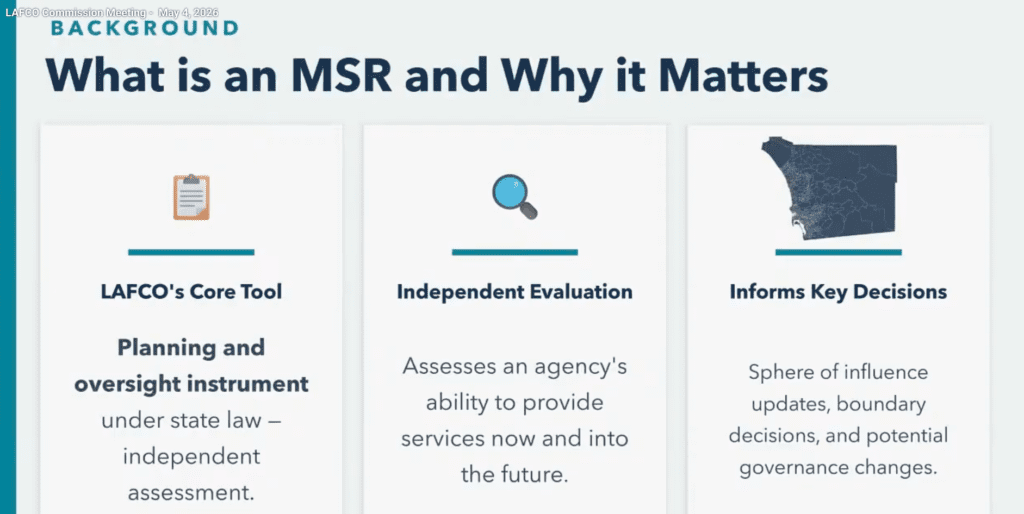
Part I of the MSR conducted a deep investigation into SDCWA dating back to at least 2008. It provided nine key conclusions, ultimately describing an agency in serious structural and financial distress. Part II would have focused on the Metropolitan Water District (MWD) and its role in serving San Diego County, had the commissioners not killed the MSR entirely.
The MSR’s Recommendations
The MSR recommended that SDCWA (1) revisit weighted voting structure & alignment with member agencies; (2) explore supplemental fixed revenue sources ; (3) support full implementation of Pure Water Phases I & II as wastewater recycling is a critical investment for the region’s water security moving forward; and (4) explore potable reuse partnerships with MWD. It also recommended that the City of San Diego review its own SDCWA board appointment practices and bloc voting structure.
The Rate Picture is Stark
From 2008 to 2023, SDCWA wholesale rates increased more than 150% — more than triple regional inflation. At the same time, SDCWA is delivering 45% less water. Fixed costs now make up over 80% of the budget expenses like debt payments, infrastructure, and long-term contracts that stay the same whether the agency sells a lot of water or a little. When sales fall short, rates go up to make up the difference.The formula is unforgiving: for every 1,000 AF less sold, SDCWA loses $1 million. Every 1% decline in sales equals a 4% increase in rates. And demand will continue to drop as local supply projects from SDCWA’s own member agencies come online.
For instance, Pure Water San Diego — the City’s landmark water recycling program — will dramatically reduce the City’s need to purchase imported water from SDCWA. These kinds of local supply projects are smart, necessary investments: they strengthen regional water independence, reduce reliance on an overallocated Colorado River, decrease pollution burdens in our oceans, and represent exactly the kind of climate-resilient infrastructure San Diego needs. But their growth comes with a direct financial consequence for SDCWA, which is precisely why the agency’s current financial model built around selling ever-larger volumes of imported water is not sustainable.
Signs of Progress, and Why They're Not Enough
The MSR acknowledged that real improvements have been made in recent years. SDCWA settled its decades-long litigation with MWD, is actively pursuing water exchange agreements with third parties, launched a business model review, and has publicly acknowledged that its take-or-pay contracts, particularly for desalinated water, present problematic debt burdens for SDCWA and its ratepayers. While Coastkeeper supports these actions, they have not definitively solved SDCWA’s serious structural and financial strains, nor its internal governance issues, as described in detail in the Draft MSR. These actions have merely begun to steer SDCWA’s billion dollar vessel away from the iceberg.
SDCWA’s governance structure is a core problem
SDCWA is governed by a 34-member board, with ten seats held by representatives from the City of San Diego (commonly referred to as the “City 10”). Because SDCWA uses a weighted voting structure based on member agencies’ cumulative financial contributions, those ten seats control 42% of SDCWA Board voting power. Thus, the City has historically served as SDCWA’s anchor member and de facto north star.
That concentration of power matters because of how the City 10’s votes actually work. If just six of the City’s ten representatives vote together, all ten votes — and therefore the City’s entire 42% share — move as a bloc. That means six unelected appointees can effectively shape regional water policy for 3.1 million county residents, even over the objections of elected officials. In practice, 20 of 34 SDCWA board members can vote “no,” and a motion can still pass.
This is precisely what happened in 2019, when the SDCWA Board voted to reject settlement with MWD — the regional wholesaler that supplies imported water across Southern California — despite the City’s own Public Utilities Department and Mayor supporting it. A minority vote also advanced further study of the boondoggle Colorado River Conveyance System, a widely criticized project that burned millions of ratepayer dollars. The City 10 also voted for the take-or-pay agreements with the Imperial Irrigation District and Channelside Water Resources — deals that bear significant responsibility for the sky-high water rates now felt across the entire county.
The structural imbalance doesn’t stop at voting power. At most SDCWA member agencies, board representatives also govern their own local water districts — meaning they’re directly accountable to the ratepayers affected by SDCWA decisions. San Diego’s City 10 operates without that alignment. The result is a recurring disconnect between what the City 10 does at SDCWA and what City leadership wants. For instance, on rate-setting and the Pure Water program, the City 10 has voted against positions taken by City Council — the elected body it ostensibly represents.
A Major Pivot at the May 4th Meeting
The purpose of the May 4 public hearing was to give Commissioners an opportunity to discuss and provide feedback on the draft report’s scope and content. LAFCO staff presented two paths forward: (a) proceed with a formal 45-day public review and comment period before preparing a final version of the MSR for future consideration, or (b) return with an updated draft MSR before advancing further.
Staff’s own recommendation was even more measured. Citing SDCWA’s recent progress (new leadership, the MWD settlement, and the execution of long-term water transfer agreements), LAFCO staff proposed a 24-month pause to allow these internal reforms time to demonstrate effectiveness. The idea was straightforward: check back in two years, assess whether measurable results warranted continued confidence, and if not, proceed with a fuller evaluation of restructuring.
The Commission chose none of the above.
Instead, it took an unannounced third path: shelving the entire MSR for four years – without even receiving the findings from Part II of the report related to MWD.
Why the MSR Was Paused
The leading voice for shelving the MSR was Commissioner Stephen Whitburn — who is notably on the Board of Directors (and City 10) for SDCWA, and a San Diego City Council member. Whitburn argued that the study period ended three years ago, that much has since improved, and that third-party water sales would address SDCWA’s revenue problem. He also defended the existing City 10 bloc voting structure.
There are serious problems with that framing. Current third-party water sales offset only 20,000 AF annually — while Pure Water San Diego Phase I and the East County Advanced Water Purification Project alone will reduce SDCWA water sales by 46,000 AF next year. Further, despite SDCWA’s claims of “upfront” payments from water sales to Eastern and Western Municipal Water Districts, those payments are actually $500,000 per month over 36 months — a payment plan, not a lump sum, and nowhere near sufficient to address the county’s rates crisis.
Future water exchange agreements may be an essential piece of the puzzle, but their rate impact remains speculative. Any such deals depend on Colorado River negotiations that are still unresolved — and if those talks collapse, the likely result is years of complex, multiparty litigation. Meanwhile, SDCWA carries billions in debt, a fixed-cost ratio over 80%, and a business model still heavily reliant on water sales — all while facing dropping demand, climate uncertainty, and member agencies rapidly developing their own local supply.
Why This Decision Is So Damaging
Let’s be clear about what happened procedurally: this item was on the agenda as a public hearing item. The commissioners ignored their own staff’s recommendations in order to shelve the entire MSR for four years, seemingly out of nowhere. In doing so, they buried their own highest-priority project for 2025-2026, without public input, and without finishing the work.
Conflicts of interest were in plain sight. Commissioner Whitburn, who simultaneously holds a position on the very board being reviewed — and wields 42% voting influence over that board — led the charge to kill the review. While LAFCO’s own rules do not require recusal for such a “representative” conflict of interest, the optics of a sitting SDCWA board member leading the arguments to completely stop work on this MSR raises major ethical concerns.
Part II was never presented. The MWD portion of this MSR was scheduled for August. The Commission voted to scrap the entire two-part review without reading or hearing the second half. This is extremely short-sighted. There is no logical reason why LAFCO should stop work on the entire MSR to effectively bury its own head in the sand prior to August.
LAFCO abandoned its leverage. The MSR was precisely the accountability mechanism LAFCO exists to provide. By shelving it for four years, LAFCO has eliminated its primary oversight tool during a period of massive structural and leadership change at SDCWA— where board leadership turns over every two years, with the next Chair selected in October 2026. This issue is too important – San Diego County is in the midst of an unprecedented rates crisis and, without significant reform within SDCWA, those rates are projected to increase another 133% by 2035.
The Bigger Picture
Water politics in San Diego County operate largely behind closed doors, and the people who benefit from the status quo have every incentive to keep it that way. The MSR threatened that status quo — not by demanding dramatic change, but by doing something more dangerous: putting structural problems on the public record, with evidence, in LAFCO’s own words.
San Diego ratepayers deserve better. They deserve a LAFCO that takes its mandate seriously, even when its findings are inconvenient for the powerful agencies it’s supposed to oversee. We deserve transparency about who is talking to whom before public votes. And they deserve elected officials who are honest about whether they can be neutral on reviews of bodies they sit on.
This fight isn’t over. The MSR’s findings don’t disappear because LAFCO voted to look away. The structural problems it documented — the take-or-pay contracts, the ballooning fixed costs, the governance dysfunction, the rate spiral — those are real, and they will continue to show up on your water bills.
What Happens Next
On May 14, 2026, a press release San Diego Coastkeeper and a coalition of 10 organizations submitted a formal letter to LAFCO urging the Commission to rescind its vote. Coastkeeper and the coalition are calling on LAFCO to resume work on the MSR, update Part I to reflect SDCWA’s recent actions, and complete Part II covering MWD. Read the full press release here.
Shelving this review leaves 3.1 million San Diego County residents without independent accountability on the agencies responsible for their water supply and rates. We will continue to push for the oversight San Diego ratepayers deserve.