





Tijuana River Sewage Crisis
This Giving Season your support helps us to protect clean water!
Tijuana River Sewage Crisis
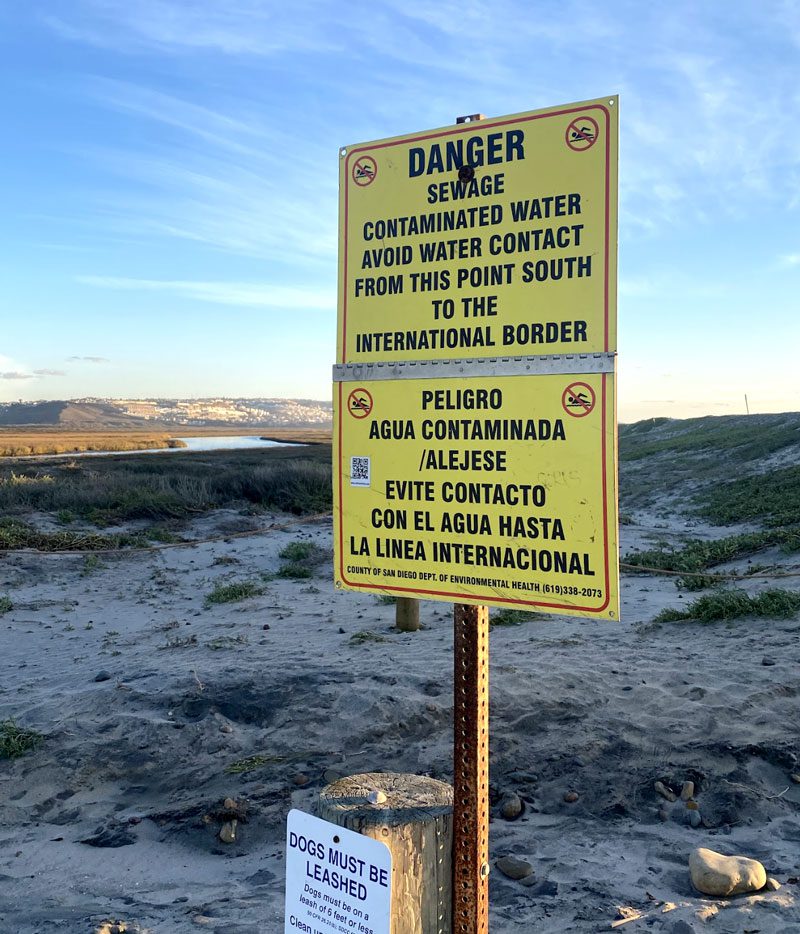
Every year, billions of gallons of toxic pollution flow across the U.S./Mexico border down the Tijuana River, bringing untreated sewage, hazardous industrial chemicals and trash into the Tijuana Estuary and Pacific Ocean. This pollution has led to years of beach closures in Imperial Beach and Coronado, and growing threats to public health from waterborne and airborne pathogens, and severe impacts to valuable coastal and marine habitats and the local economy.
Imperial Beach’s public beach was closed for Over 1,000 consecutive days.
The failure to treat the sewage is a complex cross-border problem, with years of neglect and lack of funding in both the U.S. and Mexico that has caused the crisis to worsen. It is now an environmental, social justice and public health catastrophe that continues to disproportionately impact communities in South County San Diego. San Diego Coastkeeper took up this issue in 2023, and we are committed to using every means at our disposal to address the Tijuana Sewage Crisis.
Do you live, work, or visit the Tijuana River Valley area?
We want to hear from you!
Help researches gather important health data! Take the Healthy Water, Healthy Air Survey led by Dr. Paula Granados from San Diego State University (SDSU) School of Public Health.


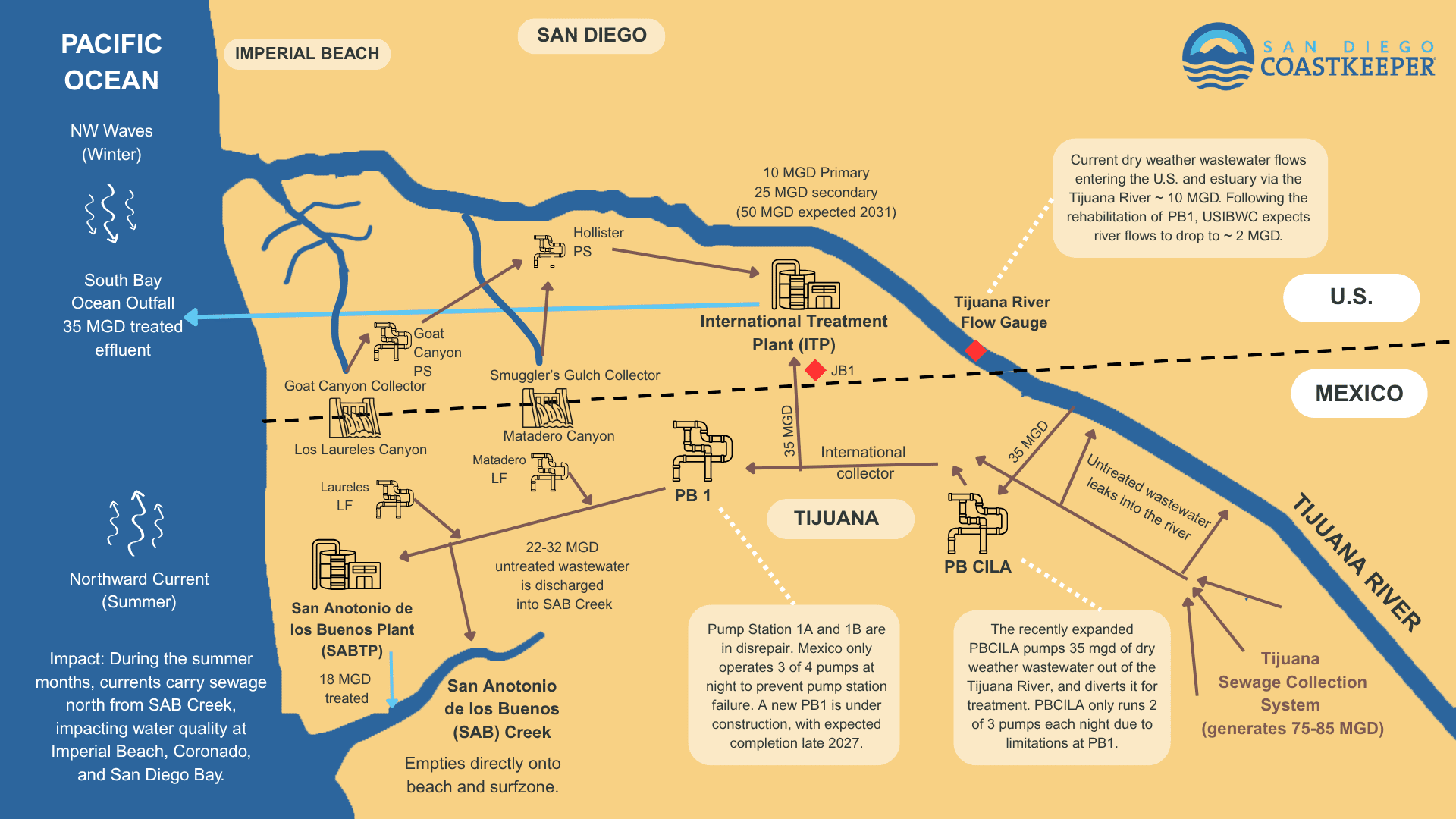
Tijuana River Wastewater Infrastructure


Tijuana River: ACTION Timeline
April 2026
Infrastructure update: Mexico Partially Restarts PBCILA, Removing Millions of Gallons of Wastewater Out of the Tijuana River
As a result, dry weather wastewater flows into the U.S. via the Tijuana River drop from 35-40 MGD to ~ 15 MGD. PBCILA helps to diverts dry weather flows in the Tijuana River to the SBIWTP, or to the San Antonio de los Buenos Wastewater Treatment Plant (SABWTP). Flows greater than the SABWTP’s 18 MGD capacity are comingled with its treated effluent and discharged directly onto the beach at Punta Bandera, approximately 5 miles south of the international border.
March 20, 2026
Infrastructure update: JB-1 Construction Completed
Junction Box 1 is a ciritical piece of infrastructure which controls flows into the SBITWP. This will allow the SBIWTP to begin treating up to new full capacity of 35 MGD.
March 2026
Tijuana River Valley Experiences Numerous Spikes in Hydrogen Sulfide Levels
The gas, associated with sewage flows and known to cause respiratory illnesses, is monitored at several stations set up along the Tijuana River by the County of San Diego. While levels of 5 parts per billion (ppb) are considered safe, air quality sensors like the one at Berry Elementary have registered numerous spikes above 300 ppb, and as high at 600 ppb. Although multiple factors can influence H2S concentration, including sunlight, sewage flows, proximity, and other environmental variables, the unusually warm March weather is likely a contributor.
December 15, 2025
The United States and Mexico Enter Minute 333
The new Minute requires a feasbility analysis of building an ocean outfall at the SABWTP, and expanding the SABWTP’s capacity from 18 MGD to 43 MGD; creation of an O&M account with NADBank; a Tijuana water infrastructure master plan to ensure water infrastructure is commensurate with anticipated population growth; and the identification of sediment and trash cature and prevention projects; among other provisions.
November 2025
USIBWC Begins the Reconstruction of Junction Box 1, PBCILA turned off
USIBWC started to repair Junction Box 1 (JB-1), a critical component that regulates flow into the SBIWTP, but intermittent rains prevented its completion for months. During this construction, as part of a coordinated effort to protect the SBIWTP, Mexico was forced to turn off PBCILA, the main pump station that diverts 35 MGD wastewater out of the Tijuana River for treatment. Thus, while JB-1 was underconstruction was down, dry weather sewage flows entering the U.S., and the Tijuana Estuary, remained at 35-40 MGD.
September 2025
USIBWC Completes the 10 MGD Expansion of South Bay International Wastewater Treatment Plant
Making good on its commitment, the USIBWC completed the expansion in just over 100 days. While this additional capacity is treated to a lesser “primary treatment” standard, this expansion allows the SBIWTP to remove 10 MGD of raw sewage that would otherwise flow into the Tijuana River and Estuary. This 10 MGD is then blended with the plants 25 MGD of “secondary treatment” effluent, and then discharged 3 miles into the ocean via the South Bay Ocean Outfall. The additional 10 MGD is a temporary stop gap while USIBWC is constructing the permanent expansion of the SBIWTP to 50 MGD.
July 24, 2025
Memorandum of Understanding between Mexico and the United States Addressing the Timing and Funding of Minute 328 Infrastrucutre Projects
In the MOU, U.S. agreed to expand treatment capacity at the SBIWTP from 25 to 50 MGD by December 2027, and release certain funding toward the rehabilitation of Pump Station 1 (“PB-1”) and Tijuana River collection pipes (“Tijuana River Gates”). Mexico agreed to divert 10 MGD of treated effluent entering the Tijuana River from the Arturo Herrera and La Morita WWTPs to a site upstream of the Rodríguez Dam, and to rehabilitate multiple wastewater collectors, interceptors, and pump stations located entirely within Mexico. More details and the status of all Minute 328 Projects can be found at this interactive portal.
July 22, 2025
Scripps Institution of Oceanography Releases Pathogen Forecasting Model
This new predictive tool utilizes data on winds, tides, offshore currents, waves, and wastewater flows to forecast sewage contamination levels and swimmer illness risk at beaches from Imperial Beach to Coronado up to 5 days in advance. While beach water quality monitoring data provides important, concrete data regarding pathogen levels, it can only determine past water quality. This new model allows families and communities to make better informed decisions health and safety decisions before going to the beach.
June 3, 2025
Binational ‘One Coastal Community’ Platform Launched
Coastkeeper and our binational collaboration of non-profit, Proyecto Fronterizo de Educación Ambienta, and academic partners, San Diego State University and Instituto Tecnológico de Tijuana, launch new website to share data and information on a centralized platform: OneCoastalCommunity.org
May 28, 2025
Study Confirms Wastewater Aerosolizes and Exposes Communities to Widespread Harms via Inhalation
A peer-reviewed study identifies Tijuana River wastewater as a source of coastal aerosol pollution, with drug metabolites, tire chemicals, and personal care products detected in air samples concentrated near the border.
May 21, 2025
EPA States it Will Make Needed Treatment Upgrades in “100 Days”
The Environmental Protection Agency’s new director, Lee Zeldin, announced that the U.S. International Boundary and Water Commission (USIBWC) declared it would fast-track an expansion of the South Bay International Treatment Plant from 25 to 35 million gallons per day “within 100 days” (or by August 29, 2025). Coastkeeper welcomes the sense of urgency, but emphasizes we will not support an approach that results in partially treated sewage and industrial chemicals being dumped into the Pacific in violation of the Clean Water Act.
April 28, 2025
San Antonio de los Buenos Operational for the First Time in Since 2020
The IBWC confirmed that, for the first time in over five years, the San Antonio de los Buenos Wastewater Treatment Plant in back online. Repairs to upgrade the plant began in early 2024. Fully functioning, the plant will be able to treat 18 million gallons per day of wastewater before discharging it into the ocean. However, due to binational system-wide capacity limitations, 20-40 million gallons per day of untreated wastewater will continue to flow into either 1) the ocean at Punta Bandera, or 2) the U.S. via the Tijuana River.
January 1 - 30, 2025
4.2 million gallon dry weather spill event
Failure of the same pressure valve that caused the June – September 2024 spill event forced a shutdown of the Goat Canyon and Smuggler’s Gulch Canyon Collectors, resulting in 4.2 million gallons of untreated wastewater spilling into the Tijuana River and Estuary.
December 21, 2024
President Biden Provides Additional $250 Million In Funding For Water Treatment
Days prior to the end of the year and his presidency, Biden approves $250 million in additional funding to the South Bay International Wastewater Treatment Plant, bringing total 2024 funding to over $800 million for critically needed repairs.


November 13, 2024
Daily Air Quality Monitoring Established to Drive Public Health Recommendations
In response to growing air quality concerns due to Tijuana River pollution—particularly high levels of Hydrogen Sulfide (H2S), an airborne byproduct of untreated sewage, decomposing organic matter, and hazardous industrial activities—The San Diego Air Pollution Control District established monitoring stations in three locations throughout souther San Diego to provide residents with reliable air quality readings and response system.


November 2024
Consistent Compliance achieved for the first time since 2020
The USIBWC South Bay International Wastewater Treatment Plant started to achieve consistent compliance with its Clean Water Act Permit effluent limitations, for the first time since at least mid-2020.
September 23 - October 29, 2024
3.4 million gallon dry weather spill event
Citing concerns that excess sediment would damage its infrastructure, USIBWC shut down the Smuggler’s Gulch Canyon Collector releasing 3.4 million gallons into the Tijuana River and Estuary.
June 17 – September 15, 2024
58.8 million gallon dry weather spill event.
The failure of a 25-year old surge tank at the Hollister Pump Station resulted in the discharge of 58.8 million gallons of untreated wastewater from Smuggler’s Gulch and Goat Canyon. Regulatory authorities later found that USIBWC had failed to inspect or maintain the surge tank since its installation date.


August 21, 2024
$400+ Million Secured To Upgrade South Bay International Water Treatment Plant
San Diego Congressional delegation secured $400 million in federal funding for the South Bay International Water Treatment Plant, effectively doubling the plant’s treatment capacity. In a perfect world, future upgrades from this funding could prevent up to 90% of untreated wastewater from reaching the coast, when working in sync with needed upgrades to treatment facilities in Tijuana.
August 8, 2024
Binational Coalition, ‘One Coastal Community’ is Formed
Coastkeeper kicked off collaboration with a binational coalition comprised of non-profit (Proyecto Fronterizo de Educación Ambiental) and academic partners (San Diego State University and Instituto Tecnológico de Tijuana) on both sides of the border to generate and share data, information, resources and knowledge to promote awareness and transparency about the Tijuana River Sewage Crisis.


April 15, 2024
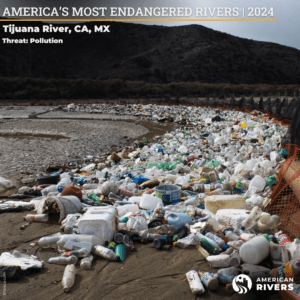
Tijuana River Designated as ‘Endangered’
The Tijuana River becomes designated as one of America’s Most Endangered Rivers® of 2024 by American Rivers, citing “pollution causing sickness, forcing beach closures, and endangering local economies”.

April 11, 2024
Coastkeeper Files Lawsuit
San Diego Coastkeeper and Coastal Environmental Rights Foundation (CERF) file lawsuit against the federal government for over 600 violations of the International Boundary and Water Commission (IBWC) South Bay International Treatment Plant’s Clean Water Act Discharge Permit.


March 22, 2024
$156 Million Approved for South Bay Plant Repairs
Congress includes $156 million in supplemental funding for the South Bay International Wastewater Treatment Plant in the FY24 budget in response to pressure from Coastkeeper’s Border Pollution Coalition.

March 11, 2023
State Bill Introduced to Hold U.S. Corporate Polluters in Tijuana Responsible
Coastkeeper supports SB1178 from Senator Steve Padilla, which would force California companies contributing to TJ River pollution to pay into a cleanup fund.

December 28, 2023
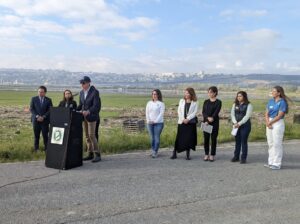
Clean Water Act Notice Filed
San Diego Coastkeeper and CERF put Feds on Legal Notice for Polluted Discharges from Border Wastewater Treatment Plant.

November 2023
Letter to President Biden
Border Pollution Coalition send letter to President Biden requesting a federal emergency declaration, and Biden’s support for increased Congressional funding to repair the South Bay Treatment Plant.
Summer 2023
Feds Admit South Bay Treatment Plant is Near Failure
IBWC admits that it needs at least $150 million of additional funding to repair the plant, following decades of neglect and deferred maintenance.


July 2022
US and Mexico adopt Treaty Minute No. 328
The US and Mexico adopt Treaty Minute No. 328, a commitment to reduce transboundary wastewater in the Tijuana River watershed and Pacific Ocean through a suite of infrastructure projects on both sides of the border. The linchpins of Minute 328 are the construction of a new SABTP in Mexico, and the expansion of the SBIWTP in the US from 25 MGD to 50 MGD. EPA fact sheet.
December 2021
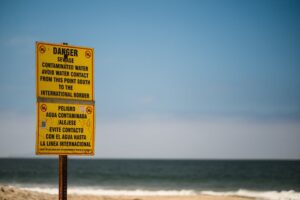
Near continuous beach closures begin in Imperial Beach
Beaches in South San Diego County begin facing dangerously high pollution levels, eventually leading to 1,000 consecutive days of closures.
December 2010
Tijuana River Mouth Designated as MPA
Tijuana River Mouth State Marine Conservation Area (SMCA), becomes designated as California’s southernmost marine protected area (MPA) due to advocacy led by San Diego Coastkeeper.
1997-2023
Cross Border Tijuana River Pollution Worsens
Failing sewage infrastructure in Mexico and negligent operation of the South Bay Plant by the U.S. government result in chronic pollution of Tijuana River and coastal communities.
1997
South Bay International Treatment Plant Completed
This 25 million gallon per day sewage treatment plant comes online, treating sewage from Tijuana and discharging it into the Pacific Ocean.
1934
International Boundary Commission Ordered to Investigate Tijuana River Pollution
Growing concerns about sewage pollution of the Tijuana River led to the eventual establishment of IBWC, treaty agreements between the U.S. and Mexico and construction of the South Bay International Treatment Plant.
ways you can help
Tijuana River Coalition
Support Clean Water
Support Important Research
Our Blogs
Learn more by checking out our three-part blog series ‘Understanding the Tijuana River Sewage Crisis’:
- An Overview of Causes and Consequences, Published: May 2, 2024
- Government Inaction & Community Responses, Published: June 13, 2024
- Tijuana River Sewage Crisis Funding Update 2025, Published: April 10, 2025
links to other resources
- TRNERR Oneonta Slough Station Water Quality with IBWC River Gage Data
- TRNERR Tijuana River Water Quality at Hollister Bridge
- San Diego County Beach Water Quality Map
- Proyecto Fronterizo de Educacion Ambiental
- EPA Tijuana River Watershed and Transboundary Pollution
- SDSU Public Health Report on Tijuana River Pollution
- City of Imperial Beach - Tijuana Sewage Pollution
- Surfrider Clean Border Water Now
- Tijuana River Coalition
- Climate Week Panel Discussion Recording


