





Written by Patrick McDonough, Senior Staff Attorney, and Courtney Brown, Staff Attorney
San Diego is often held up as a model of water resilience. In a region battered by drought, officials here are quick to boast that the taps keep running — that we’ve solved the water problem. We’re even selling our surplus to neighboring regions. Crisis averted, right?
Not exactly. Behind that confidence lies a far more complicated story: San Diego residents pay some of the highest water rates in the nation. Even as conservation efforts have driven actual water use to historic lows, rates continue to climb. To the average ratepayer, that doesn’t quite add up. Isn’t saving water far cheaper than producing it? So what’s really driving these increases? The forces behind your water bill involve staggering debt, flawed planning, and an agency that may have spent billions on water infrastructure we never needed. Here’s what every San Diegan should know.
Where Does San Diego's Water Come From?
By the time water reaches a San Diego faucet, most of it has traveled hundreds of miles — over mountains, through deserts, across fault lines. Our region sits far from major snowpacks and rivers. Our groundwater aquifers are minimal. Our climate, famously pleasant, gives us only about eleven inches of rain per year. As a result, San Diego imports roughly 70% of its water supply.
Managing our region’s water supplies is the job of the San Diego County Water Authority (SDCWA), a public agency which serves as the region’s water wholesaler. SDCWA is tasked with securing water supplies, building and maintaining infrastructure, and managing long-term water planning for its 22 member agencies and 3.3 million residents. With a billion-dollar annual budget, the SDCWA is likely the biggest, most important public agency you have never heard of.
SDCWA itself historically purchased much of its water from the Metropolitan Water District of Southern California (MWD), the largest water wholesaler in the U.S., serving 19 million people across the region. MWD has long imported the bulk of its supply via the Colorado River Aqueduct and the State Water Project, massive water conveyance systems that made Southern California’s growth possible.
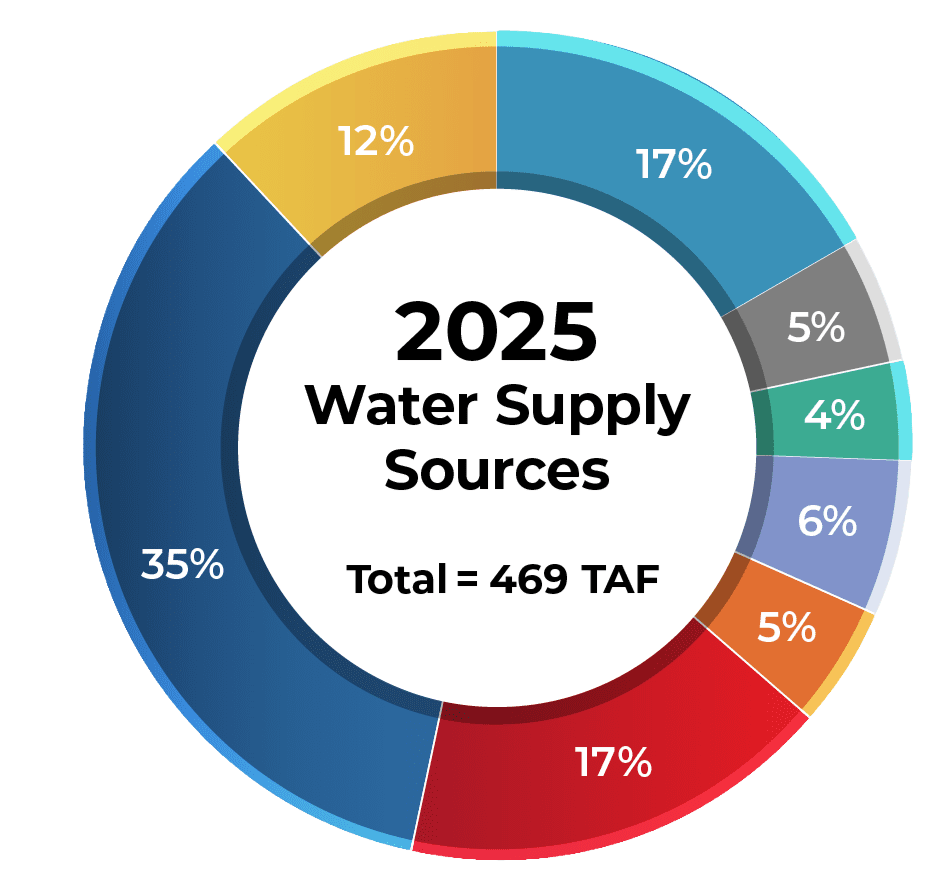
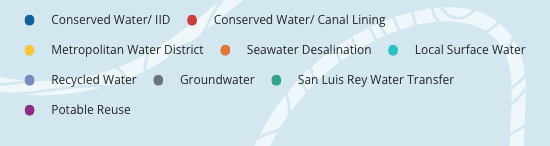
Note: “Conserved Water/ IID and “Conserved Water/ Canal Lining” are the QSA supplies described below.
The Drought That Changed Everything
In the late 1980s, California entered a severe drought. By 1991, San Diego’s water supply consisted of 95% MWD-sourced water and just 5% local surface water. When MWD approved a 50% cut in deliveries to SDCWA — ultimately scaled back to just 31% — the outrage in San Diego was intense. While the entire state was suffering from the drought, San Diegans felt treated unfairly by the Los Angeles-based MWD. As a result, resentment, along with several lawsuits, simmered between SDCWA and MWD for decades.
The late ‘80s to early ‘90s drought spurred Water Authority SDCWA to pursue its own supply agreements, outside of MWD, most notably via the Quantification Settlement Agreement (QSA) in 2003, a landmark deal that secured multiple long-term water transfers from the Imperial Irrigation District, the largest irrigation district in the U.S., which possesses the largest single share of Colorado River supplies.
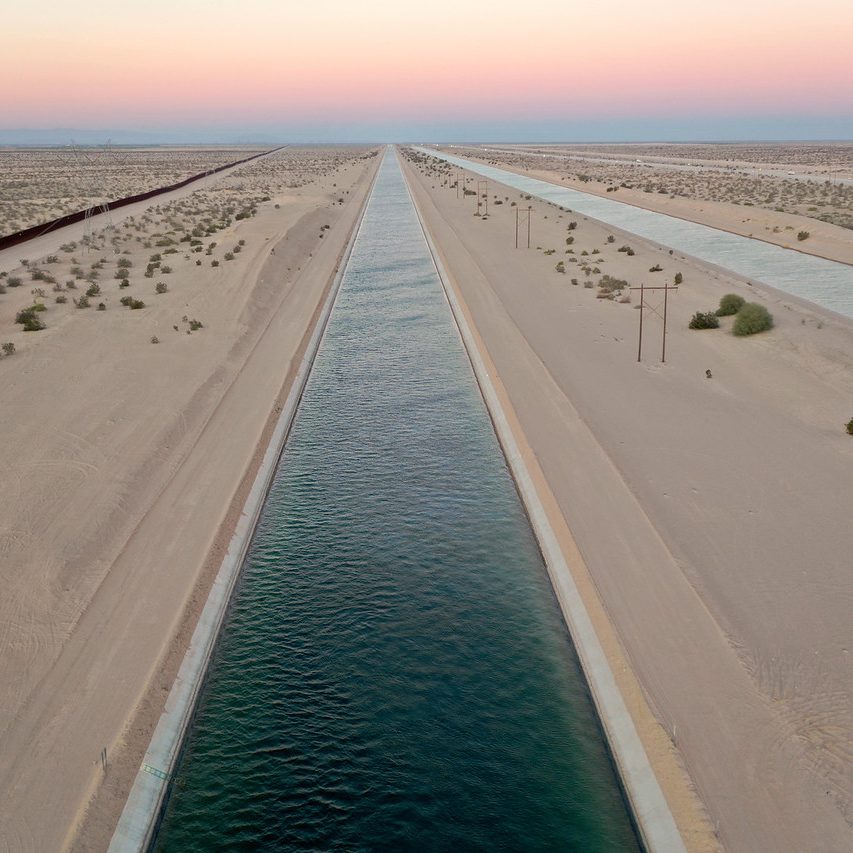
Under the QSA, SDCWA lined the All-American and Coachella canals with concrete to reduce seepage losses, provided agricultural conservation equipment, and continues to fund environmental mitigation for the ecologically distressed Salton Sea. Thus, while SDCWA obtained the rights to 277,000 AF of conserved water, it was an enormously expensive arrangement for SDCWA, which will continue to pay down billions in financed debt for decades to come.
The Demand Forecasting Disaster
Water supply agencies throughout California are required to submit an Urban Water Management Plan (UWMP) every five years. These UWMPs must include a demand forecast — a long-term projection of how much water an agency will need to supply — that extends at least twenty-five years into the future. These projections lay the groundwork for how much water supply infrastructure to build, and relatedly how much debt to take on. As most major water supply projects cost billions of dollars to be paid down over multiple decades, getting the demand forecasting correct is critical. Underestimate demand, and you could run out of water. Overestimate demand, and you create multi-billion dollar stranded assets, and skyrocketing water rates.
As you may have surmised, SDCWA’s demand forecasts were wrong. Dramatically wrong. They failed to account for a clear trend that was happening throughout California: the decoupling of population growth from water use. San Diegans were conserving water. Toilets got more efficient. Landscaping changed. Water consumption dropped sharply, even as the population grew. And yet, the agency’s models, developed largely in a “black box,” shielded from meaningful public scrutiny, continued to incorrectly predict a population-driven surge in water demand that never materialized. Moreover, SDCWA repeated these same demand forecasting errors every five years for decades.
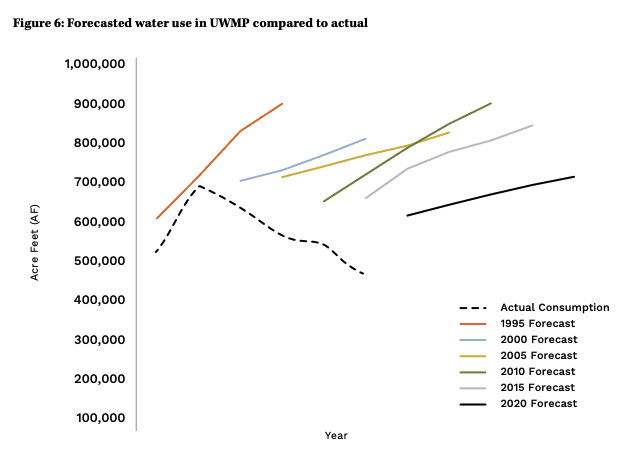
The numbers tell the story starkly. Where the Water Authority once projected selling hundreds of thousands of acre-feet more annually, actual sales have come in far lower. When you design a financial structure around selling 900,000 acre-feet of water per year and end up selling fewer than 500,000 acre-feet, you have a serious problem. As a result, the agency must dramatically raise the price per unit of water to service its debts — which is exactly what has happened at SDCWA, and the primary reason why San Diego’s water rates are among the highest in the nation.
The Desalination Double-Down
Rather than reckon with these miscalculations, SDCWA doubled down on the Claude “Bud” Lewis Carlsbad Desalination Plant, the largest ocean desalination facility in the Western Hemisphere.
Environmental groups, including San Diego Coastkeeper, warned that the project was an expensive, energy-intensive boondoggle, as well as completely unnecessary in light of conservation and efficiency trends. Those warnings went unheeded, and the Carlsbad facility now produces by far the most expensive water in the region, approaching $4,000 per acre-foot. SDCWA has also locked ratepayers into a take-or-pay contract with a foreign-based investment company that owns the plant: it must purchase a fixed quantity of desalinated water every year through 2045, regardless of whether the region needs it.
As a result of SDCWA’s demand forecasting errors and overdevelopment of supplies, the agency is now obligated to purchase more water than it can sell to its member agencies. Burdened with debt, SDCWA is financially incentivized to sell as much water as possible, rather than responsibly stewarding a finite and increasingly strained resource.
The Equity Problem Nobody Talks About
Water rates in San Diego aren’t just high — they’re inequitable. Because SDCWA structured its long-term finances around selling a certain volume of water and has fallen far short of its own projections, it has raised rates across the board. The burden of higher rates falls disproportionately on lower-income households, which can least afford them and, ironically, use less water. Meanwhile, large residential estates with sprawling lawns and high irrigation needs, whose owners are less impacted by rate increases, have driven the demand used to justify expensive infrastructure development.
Better Options Exist
The cheapest “source” of water has always been conservation. Using less water does not require massive infrastructure, long-term debts, nor 30-year take-or-pay contracts. San Diego’s conservation success over the past two decades is a genuine achievement — but it happened despite the Water Authority’s planning models, not because of them.
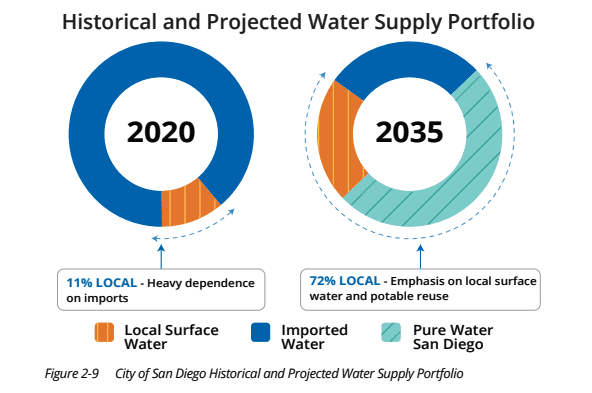
In contrast to the Carlsbad Desalination Plant, the region’s utility-owned wastewater recycling projects like Pure Water San Diego represent a holistic and sustainable response to the region’s water supply and affordability conundrum. They produce local, drought-proof supply that is cheaper to produce, less energy-intensive, and significantly better for the environment than desalination. By 2035, Pure Water San Diego is projected to supply one half of the City’s total water needs, dramatically reducing the City’s reliance on costly imports.
The economics are also compelling. Pure Water is projected to cost less per acre-foot than water purchased from SDCWA, because costs are spread between wastewater treatment and potable supply development. That advantage will only grow as imported water prices continue to rise. More broadly, Pure Water represents a fundamental shift in how San Diego sources its water, moving away from a model defined by distant supply chains and unpredictable costs, and toward one built on local resilience, environmental stewardship, and long-term affordability.
What Comes Next
Thankfully, we’re finally starting to see encouraging signs of course correction. SDCWA’s current draft 2025 UWMP (which is open for public review and comment until April 25) reflects a welcomed departure from its predecessors. For the first time, demand projections appear to align with actual consumption trends rather than assuming perpetual growth, signaling a meaningful step toward rightsizing the agency’s planning for the future.
In June 2025, SDCWA and MWD settled their 15-year legal battle, which opened the door for new, regional collaboration. Thanks to this settlement, SDCWA is actively working to sell off excess water supplies to other agencies, with completed deals expected to help moderate future rate increases. These water transfers are a win-win. We need to sell off water to help alleviate our rates crisis, and other regions are in desperate need of water, due to dwindling snowpacks in the Sierra Nevadas and Rocky Mountains.
The Colorado River, the backbone of water supply for 40 million people across the American West, is in crisis. Decades of over-allocation, combined with climate change, have brought reservoir levels near historic lows. Federal intervention, interstate litigation, loss of hydroelectric power for millions, and even reaching deadpool — when reservoir levels are so low that they no longer flow downstream — are no longer hypothetical risks; they are imminent threats.
What You can do
Water policy can feel abstract until it shows up on your bill. But the decisions that drive those bills are made in public meetings by appointed and elected officials who answer to ratepayers. Here’s how to make your voice heard.
Attend a SDCWA board meeting. The next board meeting will be held on May 28th. Board meetings occur on the second-to-last Thursday of each month. Members of the public can comment on any agenda item or submit non-agenda public comments at the start of any committee or full board meeting. Sign up to receive email notices when new agendas are published!
Review and comment on the draft 2025 UWMP. Public comments on the draft 2025 Urban Water Management Plan are accepted through April 25th. This is a direct opportunity to weigh in on the demand forecasts that will shape infrastructure decisions for years to come!
Know your representatives. Find out which City of San Diego representatives sit on SDCWA’s board and contact them directly. They hold real influence over the decisions that affect your bill.
Support local supply investments. When projects like Pure Water come before City Council, show up. Local, sustainable water supply is one of the most effective tools San Diego has to reduce its dependence on expensive imported water and stabilize rates over the long term.