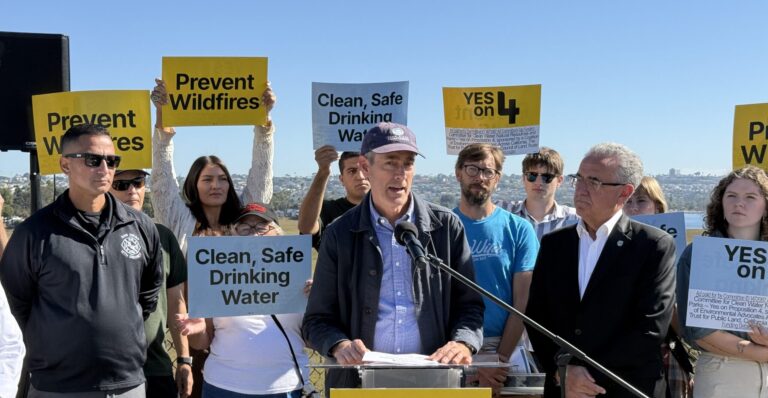




Senator Ben Allen’s SB 601, the Right to Clean Water Act, is a critically important bill that aims to strengthen California’s clean water law, the Porter Cologne Act, by ensuring that waterways previously protected under federal law would continue to be protected under state law. In the wake of the U.S. Supreme Court’s Sackett decision, the Court severely narrowed the types of streams and wetlands covered under the federal Clean Water Act, leaving millions of miles of rivers and streams and millions of acres of wetlands vulnerable to unregulated pollution. If passed, SB 601 would safeguard the state’s streams and wetlands from further federal rollbacks that put public health and our shared waters at risk. California has already lost over 90% of its ecologically valuable wetlands. In San Diego, many of our small creeks and streams, and even the Otay and Tijuana Rivers, are potentially vulnerable without the added protection of this bill.
Supported by the California Coastkeeper Alliance, Defenders of Wildlife, and the Right to Clean Water Act would effectively uphold the Clean Water Act, prior to the Sackett v. EPA decision, which rolled back important federal protections to waters of the United States (WOTUS). The new provisions proposed by SB 601 would amend the state’s Porter-Cologne Act with a newly defined category of waters, called “nexus waters,” which would re-protect all pre-Sackett v. EPA WOTUS in California. The bill would also provide the State Water Board with clearer and more efficient authority to regulate companies and municipalities that discharge pollution into public waterways. The original bill also included a state citizen suit provision akin to federal law, which would have allowed clean water advocates like Coastkeeper to hold polluters directly accountable in state court.
If this doesn’t sound like a big deal, consider that, not long ago, it was legal to discharge pollutants directly into the nearest body of water. Rivers, lakes, and wetlands were often used as garbage dumps for industrial refuse, like heavy metals from manufacturing, oil from refineries, and chemical pesticides from agriculture. After a series of environmental disasters—including the Cuyahoga River catching on fire—the Clean Water Act established strict protections for national waters in 1972.
“We are not going backward. California has enjoyed clean water protections for 50 years, and we have a right to continue to do so,” said Sean Bothwell, Executive Director for California Coastkeeper Alliance. “The Right to Clean Water Act preserves California’s values in the face of turbulent federal disruptions, while efficiently moving the state’s clean water programs forward.”
Progress of The Right to Clean Water Act
The Right to Clean Water Act passed the Senate Environmental Quality Committee by a 5-3 vote on April 2nd, 2025. But in order to ensure passage on the Senate floor, the bill’s author, Senator Ben Allen, amended SB601 to omit the citizen suit provision and replace it with a third-party enforcement provision, similar to what is currently in state law to enforce clean air requirements. While the loss of the citizen suit provision limits Coastkeeper’s ability to enforce state law, we continue to support the bill and would seek to expand our relationships with the State Water Board, city attorneys, and other public law enforcement entities to facilitate acting as third-party enforcers on behalf of the public.
Successful legislation nearly always involves compromise and tough choices, and this is no different. On balance, the Right to Clean Water Act will strengthen California’s clean water law as a bulwark against further federal actions to undermine fundamental environmental rights. We continue to support the Act and look forward to its passage.
Keep an eye on our newsletter and social media for how you can help us call upon our government to help bring SB 601 into law, including contacting your Assemblymembers to voice support for the bill.